Foxtail Flats: Solar Power and Battery Storage
- Project scheduleCompletion anticipated by Spring 2027
- Contractor nameDESRI
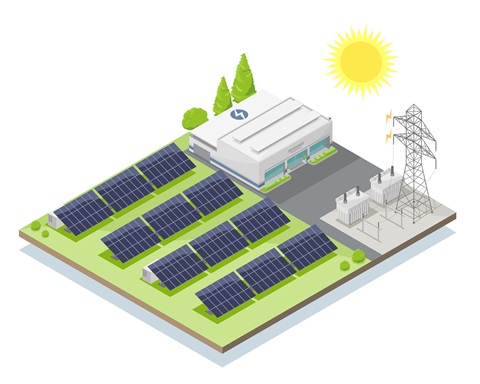
In 2016, the Los Alamos Board of Public Utilities (BPU) set a goal for the Department of Public Utilities (DPU) to become a carbon-neutral electrical energy provider by 2040. The Foxtail Flats Solar and Storage agreements will bring 170 megawatts (MW) of solar power from the Four Corners area as an energy resource for Los Alamos County, as well as 80 MW/320 MWh of battery storage. This project was approved by Council in February 2024. The Foxtail Flats project is being developed by DESRI (D.E. Shaw Renewable Investments).
General: Foxtail Flats is a 170-MW solar energy project, paired with 80 MW/320 MWh of battery energy storage. The project will be located on the Ute Mountain Ute Reservation and private land about 10 miles northwest of Farmington, NM. The project will interconnect to an existing substation at DESRI’s San Juan Solar project roughly 5 miles to the southwest of Foxtail Flats, which is connected to the electric grid at the retired San Juan Generating Station substation by an existing generation transmission line. The combined San Juan Solar and Foxtail Flats will generate over 500,000 MWh annually. For context, the average New Mexican house consumes 10-12 MWh per year.
Foxtail Flats Solar will provide significant benefits, including:
- Supplying over half of Los Alamos County's, Los Alamos National Laboratory's, Sandia National Laboratory's and Kirtland Airforce Base's electrical load with clean, low-cost energy
- Helping the Ute Mountain Ute Tribe meet the goals of their Climate Action Plan
- Creating over 200 construction jobs
- Increasing the overall supply of clean, renewable energy on the grid
Site Selection: This location was selected after analyzing other suitable sites and using selection criteria, including:
- Minimization of impacts to sensitive natural resources, culturally important areas, and wildlife habitats
- Access to existing transmission system with capacity
- Utility interest in increasing regional renewable energy generation and offsetting lost fossil fuel generation
- Favorable land conditions
DESRI contracted with Barr Engineering to complete a variety of physical, cultural, and natural resource investigations of the project footprint.
Timeline:
- January 2023: DESRI signs a land option agreement with Ute Mountain Ute Tribe
- February 2024: DESRI converts option agreement to a lease agreement with the Ute Mountain Ute, ultimately covering 3,962 acres
- March 2024: Power Purchase Agreement and Energy Service Agreement executed with Los Alamos for 170 MW PV and 80 MW BESS Foxtail Flats
- August 2025: Permitting completed
- May 2026: Groundbreaking event
- Q2 2027: Anticipated commercial operation
Project Status: Preliminary site prep (road work and final engineering studies) started in January 2026. A groundbreaking ceremony was held May 14, 2026 and equipment mobilizations was well underway. As of early June 2026, site clearing and steel pile installation for panels had started.
NPR recently featured this project from the perspective of the Ute Mountain Ute Tribe. Read or listen to the feature at Despite stiff political headwinds, tribe in Colorado brings utility scale solar project online.
Photo credits to DESRI (site map, decommissioning, and solar project aerial); Matt Heavner (groundbreaking with people); Ben Olbrich (machinery and equipment)
How much power will this produce? Will it be enough?
This project will produce 170 MW during clear sunny daylight hours, which is more than enough to supply the 90 MW peak daytime load for the Los Alamos Power Pool (LAPP), which is the partnership that meets the combined energy needs and resources for Los Alamos County (LAC) and Los Alamos National Laboratory (LANL). DPU will also supply Sandia National Laboratory and Kirtland Air Force Base (Sandia/Kirtland) with 30 MW of power, charge the Battery Energy Storage System (BESS) with solar power, and sell any excess solar power.
How much energy will the battery store? How long will it provide power if used?
The BESS will provide a maximum power capacity of 80 MW continuously for 4 hours, with a total energy capacity of 320 MWh. The system can also be discharged at lower power levels for longer times, such as 25 MW for 12.8 hours.
Isn't this an expensive source of energy?
The daytime power is relatively inexpensive at $37.88/MW for the entire 20-year term of the project. That being said, the BESS is more costly due to the current cost of storage technology. The blended cost for the combined resource is about $74/MW, which is a little bit less than long-term market power purchase agreements at the time the solar and storage agreements were signed.
When will we start receiving power from Foxtail Flats?
The planned full operational capability is June 2027.
With the solar field being in the Four Corners area, how will we get this power?
Power will flow into PNM's San Juan 345kilovolt (kV) substation and transmission lines to reach Los Alamos County.
Why do we need a battery?
The battery will serve two purposes: It will help to supply night load of up to 320 MWh for LAPP and Sandia/Kirtland. And, it will store some or all excess solar power, lowering the need to sell excess solar power.
What happens when we enter a stormy period without much solar production?
Our day-ahead and real-time scheduling desk will purchase power from suppliers to make up the difference. This is already a regular operational task under DPU's Electric Production division, not an unusual circumstance resulting from this project.
Who are the project owners?
Los Alamos County will not own any of the Foxtail Flats assets. Foxtail Flats Solar, LLC, and Foxtail Flats Storage, LLC, are the asset owners.
Contact details
Ben Olbrich
(505) 662-8140
Location
6800 N County Rd, Waterflow, NM, 87421 View Map
36.760157,-108.4942722
6800 N County Rd, Waterflow, NM ,
87421
6800 N County Rd, Waterflow, NM ,
87421
Foxtail Flats: Solar Power and Battery Storage